
Rekindle
A ritual space to grow with people beside you.
Beyond productivity: Creating a space for gentle, identity-based growth

Project
Overview
Rekindle is a ritual space for identity-based habit-building — a digital habitat where growth feels grounded, emotional, and deeply supported. Unlike traditional productivity trackers that pressure users to maintain streaks, Rekindle helps individuals build flexible, meaningful habits through reflection, gentle consistency, and soft group accountability.
The Problem

When habit apps become another source of pressure
Most habit apps treat growth as a game — streaks, graphs, and productivity metrics. However, life rarely unfolds in a perfect daily routine. For people navigating burnout, transition, or emotional fatigue, these tools often become just another pressure point, impersonal, and emotionally disconnected, leading to abandonment.
This led me to a guiding question:
How might we create a flexible ritual space for habit-building, so users can grow in a way that feels emotionally aligned, personally meaningful, and supported over time — rather than pressured or judged?
The Process

Designing with the Double Diamond: from listening to delivery
Rekindle followed the Double Diamond design thinking framework, which guided the project from research to prototyping and delivery. The model emphasizes divergence and convergence at each stage — opening up to explore possibilities, then narrowing down to focus on the most meaningful solutions.



The discovery phase focused on understanding users’ needs, motivations, and struggles with existing habit-building tools. I conducted surveys, social listening, and a review of behavioral psychology literature
(Atomic Habits by James Clear).
Listening to users and learning from behavior

Discover
What people told us: the need for small, supportive groups
To understand how people approach habits, I surveyed 15 adults about their experiences with habit trackers, accountability, and emotional support. Their responses revealed not just what they want from an app, but what they truly need: flexible, emotionally supportive spaces that help them stay connected.
"I’d like to be a part of a small group that will keep me accountable with what I want to change. Also, knowing that other people go through the same challenges will keep me motivated to do better."
"I’d definitely prefer to do the challenge in small groups. Solo can be great at times for deep reflection, but having others to lean on during tough days or to share successes with makes the whole experience more motivating and fulfilling."
Grounding the design in behavioral science
To ground Rekindle in behavioral science, I drew from James Clear’s Atomic Habits and focused on three principles that shaped the user experience:
-
Identity drives consistency →
People stick to habits when they align with who they want to become, not just what they want to achieve
-
Environment matters →
A soft, emotionally supportive space lowers pressure and prevents fatigue.

“Your identity emerges out of your habits.”
– James Clear,
Atomic Habits
-
Accountability sustains growth →
A gentle group belonging motivates users more than a competitive streak.
Define
Where existing habit apps fall short
To position Rekindle, I analyzed existing habit-building tools, including Squad, Habitica, and Fabulous. While each offered useful approaches — from social streaks to gamified rewards to guided routines — all left critical gaps.
Competitive Analysis Approach
These gaps shaped Rekindle’s design opportunities, particularly around identity rituals, soft accountability, and emotional pacing.

Jhoanna
“Some days I just want to feel like I’m making progress, even if it’s just a little.”

Personas: who we’re designing for
To ground the design in real needs, I developed user personas from survey data, social listening, and behavioral insights.
One key profile, Jhoanna, represents the emotional center of Rekindle’s audience:
-
A working student balancing school and part-time work.
-
Ambitious but often exhausted, she struggles with motivation, guilt, and staying consistent.
-
She wants gentle accountability and a safe, non-judgmental space to build habits that support her well-being.
Additional personas (3 more) were also developed to represent varied user mindsets and needs.”
Journey Mapping: tracing the frustration
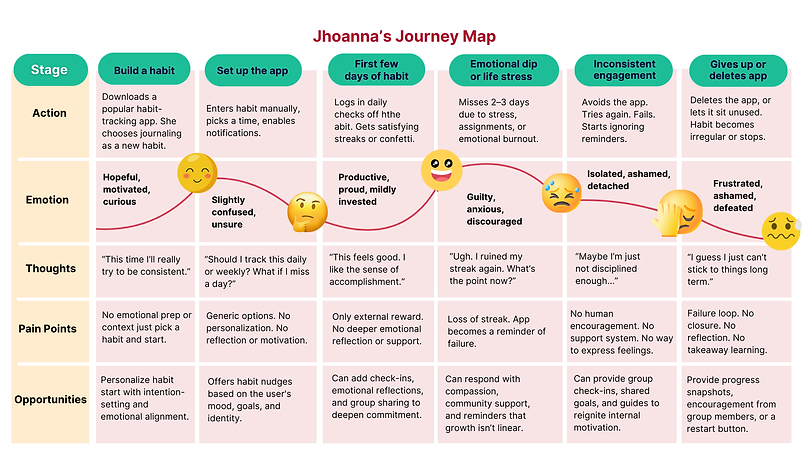
The journey map revealed a common emotional pattern: users start motivated, but quickly face confusion, guilt, and disengagement. The issue isn’t effort; it’s the lack of emotional scaffolding, reflection, and human connection. These insights shaped Rekindle’s design to integrate journaling, mood check-ins, and soft accountability.

Develop
Designing a Habitat for Growth
Rekindle is built around the metaphor of a campfire — a space of quiet strength, warmth, and communal growth. Like a fire that is carefully tended, habits grow not through pressure but through consistent care and reflection. The name Rekindle reflects the act of relighting one’s inner fire: the freedom to begin again without shame.

This theme guided every design decision:
-
Visual Style →
Soft, grounded color palette; minimalist layouts using flat design and subtle neumorphism;
-
Tone of Voice →
Empathetic, affirming, modeled after a wise companion. Nudges encourage rather than pressure.
-
Growth →
Progress framed as “adding kindling” — small, steady steps that fuel sustainable growth.
Designing with identity in mind
Through research, it became clear that users abandon habit apps not because of laziness, but because the tools feel disconnected from who they are. Identity-based behavior, supported by behavioral science, suggested that growth is more sustainable when habits align with the person users aspire to become.
To reinforce this, I introduced animal guides as symbolic companions. Instead of abstract avatars or gamified badges, each animal embodies a trait that users can anchor their journey to. These guides resurface during check-ins and milestones as subtle reminders of the identity the user is growing into.
 |  |  |
|---|---|---|
 |  |  |
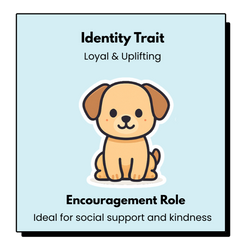 |  |
By framing habits through identity, the animal guides transform routine actions into a meaningful narrative. Instead of “I checked off a habit,” users feel “I’m becoming more resilient, more focused, more grounded."
Designing the Experience
At the heart of Rekindle are three rituals designed to balance support, reflection, and accountability. Each one responds to a user pain point uncovered during research:
Habit Check-In Rituals

Instead of streaks or pressure, Rekindle uses quick reflection prompts that encourage users to log habits with intention. The focus is on consistency that feels supportive, not punishing.
Journaling for Reflection

Users can capture their thoughts in text, voice, photo, or video. Prompts guide deeper reflection, while private entries allow them to revisit progress over time.
Micro-Community Circles

After Day 3, users join a small Growth Circle with peers who share similar goals. Light-touch features like “Hug” and “Motivate” reactions foster gentle accountability and a sense of belonging.
Usability Testing – Early Validation
I conducted usability testing sessions with participants who matched my target audience of busy students and young professionals. The goal was to validate the clarity of the flow and the emotional tone of the interface.

Describe your image

Describe your image

Describe your image
Usability Testing – Early Validation
One usability test revealed that focusing on four broad habit categories felt limiting. Users wanted to choose habits tied to their real-life challenges. Based on this insight, I redesigned the flow to let users start with a personal challenge, making the experience more relevant and motivating.
Other refinements were made based on testing feedback, such as simplifying navigation and clarifying Growth Circle onboarding. These changes are reflected in the final prototype.

Before: Habit categories
After: Real-life challenge selection

Deliver
Rekindle in Action


The final high-fidelity prototype brought Rekindle’s vision to life: a warm, supportive habit-building platform designed around reflection, identity, and gentle accountability. From onboarding and habit selection to journaling and Growth Circles, the prototype demonstrates how each step feels intentional and emotionally grounded.

Promo Website & Video
To introduce Rekindle’s concept, I also created a promotional website and a short video. These assets were designed to communicate Rekindle’s unique value: habit-building with kindness, not pressure. The promo emphasized the theme of “sharing the warmth,” inviting users to see growth as a shared journey.


Reflection
What I Learned
Rekindle was more than just a design project — it was a lesson in how to design for emotions, not just functions. I learned that small changes, like replacing streaks with reflection prompts, can reshape how users feel about habit-building.
I also grew in collaboration and communication, especially when sharing my ideas with mentors and peers. Creating both a prototype and a promo taught me how design connects with storytelling and strategy.
Most importantly, Rekindle showed me that habit-building can be rooted in kindness, community, and identity — values that I want to carry into my future projects.

